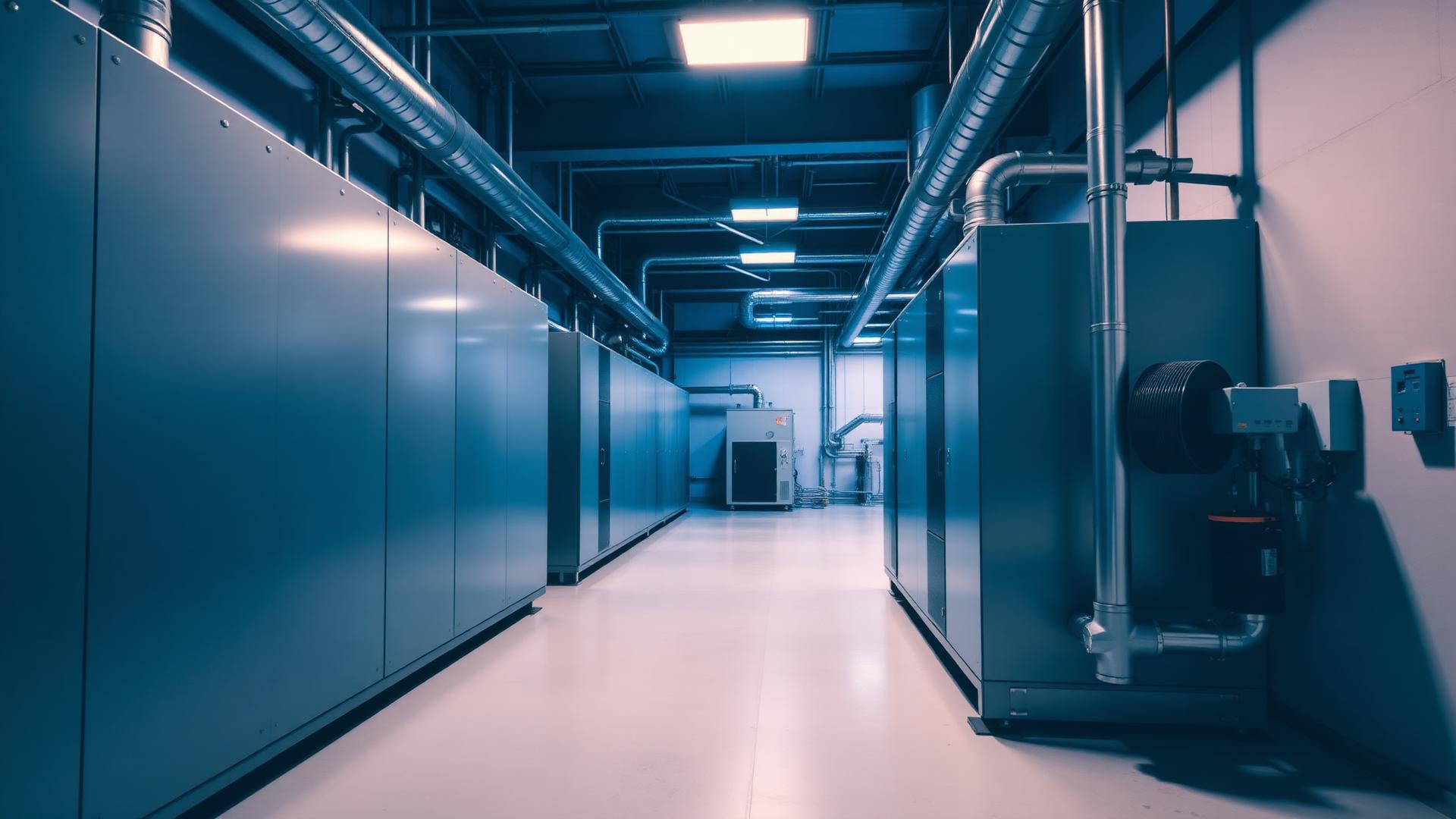
Industrial cooling system — outdoor chiller installation
Industrial cooling systems

Industrial cooling systems for water, liquid and process cooling

Engineered chillers, heat pumps and free cooling that hold your process setpoint 24/7 — sized to your real duty cycle, built for a long service life and low energy costs.

Overview

What an industrial cooling system does

An industrial cooling system removes process heat from machines, moulds, tools or reactors and rejects it to the ambient air or a cooling water network. Compared to comfort HVAC, industrial equipment is built for continuous duty, a precise temperature setpoint and predictable ownership cost over 15+ years of operation.

EnergyCooling engineers three variants of the same platform: water cooling for plain-water process loops, liquid cooling for water/glycol and sub-zero setpoints, and full process cooling where chiller, free cooling and heat recovery are integrated into one control strategy.

Technical highlights
Low-GWP refrigerants
Load-following capacity control
Built for 24/7 operation
Free cooling integration

Industrial water cooling

Closed-loop water circuits keep process temperatures stable for injection moulding, welding, laser cutting and hydraulic power packs. We size the chiller, buffer tank and pump set to the real duty cycle instead of nameplate peaks.

  • Air- or water-cooled chillers from ~5 kW to > 1 MW
  • Closed-circuit design — no evaporation, no water treatment overhead
  • Setpoints typically +7 to +25 °C at ±1 K stability
  • Optional buffer tank sizing for pulsed loads
Discuss this configuration →

Industrial liquid cooling (water/glycol)

For setpoints below +5 °C, outdoor installations at risk of freezing, or processes needing corrosion protection, we run a water/glycol mix through the same chiller platform. Heat exchangers, pumps and seals are matched to the fluid.

  • Ethylene- or propylene-glycol mixes for setpoints down to −25 °C
  • Outdoor-rated cabinets with freeze protection
  • Compatible with reversible heat pumps for combined cool/heat duty
  • Low-GWP refrigerants (R-1234ze, R-513A, R-290)
Discuss this configuration →

Process cooling systems

Process cooling is designed around the machine, not the room. We map the thermal load per production step, then combine chillers, drycoolers and free cooling into one control strategy that follows the actual process curve.

  • Load-following control with variable-speed compressors and pumps
  • Free cooling integration for 40–70% annual energy savings
  • Heat recovery to process water, wash-down or space heating
  • 24/7 monitoring, alarming and Modbus / BACnet integration
Discuss this configuration →
Applications

Where these systems are installed

Plastics — injection moulding, extrusion, blow moulding
Metalworking — laser cutting, welding, CNC spindle cooling
Food & beverage — process water, cold rooms, brewing
Data & telecom — server rooms and edge cabinets
Pharma & chemical — reactors, condensers, jacket cooling
Rubber, composites and 3D-printing production lines

Browse full application detail on our applications page or the cooling systems range.

FAQ

Industrial cooling systems — questions

What is an industrial cooling system?

An industrial cooling system removes process heat from machines, moulds, lasers or reactors and rejects it to the ambient air or a cooling water network. Most systems circulate water or a water/glycol mix through a chiller, heat pump or dry cooler to keep process temperatures within a tight setpoint.

What is the difference between water cooling and liquid cooling?

Water cooling uses plain water as the heat-transfer fluid and is common where freezing is not a concern. Liquid cooling is the broader term and includes water/glycol mixes, thermal fluids and refrigerants — used when the process runs below 0 °C, needs corrosion protection, or requires a specific fluid chemistry.

When should I choose process cooling instead of comfort cooling?

Process cooling is designed for continuous 24/7 duty at a precise, often lower setpoint (typically +5 to +25 °C). Comfort cooling equipment is not built for that load profile and fails prematurely on production lines, injection moulding, lasers and CNC spindles.

Air-cooled or water-cooled chiller — which is better?

Air-cooled chillers are simpler, need no external cooling water and are ideal for outdoor placement. Water-cooled chillers reach higher efficiency at high load and are the better choice when a central cooling-water network is already available or ventilation is limited.

How much can free cooling reduce my energy bill?

For process water setpoints from +10 °C upwards, free cooling in a Northern European climate can cover 40–70% of the annual cooling energy — the compressor only runs on warm days. The exact saving depends on setpoint, ambient profile and load pattern.

Quote

Get a quote for your industrial cooling system

Tell us the required capacity, temperature setpoint and the application. We reply within 1 business day with a sized configuration and indicative pricing. Replacing an existing chiller? Your old installation can be traded in.

We nemen binnen 1 werkdag contact met u op. Uw gegevens worden niet gedeeld met derden.